















Automotive Fuel Economy Program: Eighteenth Annual Report to the Congress |
|---|

|
Barry Felrice
Federal Register
March 3, 1994
[Federal Register: March 3, 1994]
-----------------------------------------------------------------------
DEPARTMENT OF TRANSPORTATION
National Highway Traffic Safety Administration
Automotive Fuel Economy Program; Report to Congress
The appended document, Automotive Fuel Economy Program, Eighteenth
Annual Report to the Congress, was prepared pursuant to section
502(a)(2) of the Motor Vehicle Information and Cost Savings Act (Pub.L.
92-513), as amended by the Energy Policy and Conservation Act (Pub.L.
94-163) which requires in pertinent part that each year beginning 1977,
the Secretary shall transmit to each House of Congress, and publish in
the Federal Register, a review of average fuel economy standards under
this part.
Issued: February 23, 1994.
Barry Felrice,
Associate Administrator for Rulemaking.
U.S. Department of Transportation
Automotive Fuel Economy Program
National Highway Traffic Safety Administration
Eighteenth Annual Report To The Congress
AUTOMOTIVE FUEL ECONOMY PROGRAM
EIGHTEENTH ANNUAL REPORT TO THE CONGRESS
Table of Contents
SECTION I: INTRODUCTION
SECTION II: FUEL ECONOMY IMPROVEMENT BY MANUFACTURERS
SECTION III: 1993 ACTIVITIES
A. Passenger Car CAFE Standards
B. Light Truck CAFE Standards
C. Low Volume Petitions
D. Enforcement
SECTION IV: USE OF ADVANCED TECHNOLOGY
A. New Models
I. Passenger Cars
a. Domestic
b. Imports
II. Light Trucks
a. Domestic
b. Imports
B. Engine and Transmission Technology
C. Electronics
D. Materials
E. Summary
Section I: Introduction
This Eighteenth Annual Report to Congress summarizes the 1993
activities of the National Highway Traffic Safety Administration
(NHTSA) regarding implementation of applicable Sections of Title V:
``Improving Automotive Fuel Efficiency,'' of the Motor Vehicle
Information and Cost Savings Act of 1972 (15 U.S.C. 1901 et seg.), as
amended (the Act). Section 502(a)(2) of the Act requires submission of
a report each year. Included in this report are sections summarizing
rulemaking activities during 1993 and a discussion of the use of
advanced automotive technology by the industry as required by section
305, Title III, of the Department of Energy Act of 1978 (Pub. L. 95-
238).
Title V of the Act requires the Secretary of Transportation to
administer a program for regulating the fuel economy of new passenger
cars and light trucks in the United States. The authority to administer
the program was delegated by the Secretary to the Administrator of
NHTSA, 49 CFR 1.50(f).
NHTSA's responsibilities in the fuel economy area include:
(1) Establishing and amending average fuel economy standards for
manufacturers of passenger cars and light trucks, as necessary;
(2) Promulgating regulations concerning procedures, definitions,
and reports necessary to support the fuel economy standards;
(3) Considering petitions for exemption from established fuel
economy standards by low volume manufacturers (those producing fewer
than 10,000 passenger cars annually worldwide) and establishing
alternative standards for them;
(4) Preparing annual reports to Congress on the fuel economy
program;
(5) Enforcing fuel economy standards and regulations; and
(6) Responding to petitions concerning domestic production by
foreign manufacturers and other matters.
Passenger car fuel economy standards were established by Congress
for Model Year (MY) 1985 and thereafter at a level of 27.5 miles per
gallon (mpg). NHTSA is authorized to amend the standard above or below
that level. Standards for light trucks were established by NHTSA for
MYs 1979 through 1995. NHTSA set a combined standard of 20.6 mpg for
light truck fuel economy standard for MY 1995. All current standards
are listed in Table I-1.
Table I-1.--Fuel Economy Standards for Passenger Cars and Light Trucks
Model Years 1978 Through 1995
[In MPG]
------------------------------------------------------------------------
Light Trucks\1\
Passenger --------------------------------------
Model year cars Two-wheel Four-wheel
drive drive Combined2,3
------------------------------------------------------------------------
1978................ \4\18.0 ........... ........... ...........
1979................ \4\19.0 17.2 15.8 ...........
1980................ \4\20.0 16.0 14.0 (\5\)
1981................ 22.0 \6\16.7 15.0 (\5\)
1982................ 24.0 18.0 16.0 17.5
1983................ 26.0 19.5 17.5 19.0
1984................ 27.0 20.3 18.5 20.0
1985................ \4\27.5 \7\19.7 \7\18.9 \7\19.5
1986................ \8\26.0 20.5 19.5 20.0
1987................ \9\26.0 21.0 19.5 20.5
1988................ \9\26.0 21.0 19.5 20.5
1989................ \10\26.5 21.5 19.0 20.5
1990................ \4\27.5 20.5 19.0 20.0
1991................ \4\27.5 20.7 19.1 20.2
1992................ \4\27.5 ........... ........... 20.2
1993................ \4\27.5 ........... ........... 20.4
1994................ \4\27.5 ........... ........... 20.5
1995................ \4\27.5 ........... ........... 20.6
------------------------------------------------------------------------
\1\Standards for MY 1979 light trucks were established for vehicles with
a gross vehicle weight rating (GVWR) of 6,000 pounds or less.
Standards for MY 1980 and beyond are for light trucks with a GVWR of
8,500 pounds or less.
\2\For MY 1979, light truck manufacturers could comply separately with
standards for four-wheel drive, general utility vehicles and all other
light trucks, or combine their trucks into a single fleet and comply
with the 17.2 mpg standard.
\3\For MYs 1982-1991, manufacturers could comply with the two-wheel and
four-wheel drive standards or could combine all light trucks and
comply with the combined standard.
\4\Established by Congress in Title V of the Act.
\5\A manufacturer whose light truck fleet was powered exclusively by
basic engines which were not also used in passenger cars could meet
standards of 14 mpg and 14.5 mpg in MYs 1980 and 1981, respectively.
\6\Revised in June 1979 from 18.0 mpg.
\7\Revised in October 1984 from 21.6 mpg for two-wheel drive, 19.0 mpg
for four-wheel drive, and 21.0 mpg for combined.
\8\Revised in October 1985 from 27.5 mpg.
\9\Revised in October 1986 from 27.5 mpg.
\10\Revised in September 1988 from 27.5 mpg.
The Alternative Motor Fuels Act of 1988 (AMFA) (Pub. L. 100-494,
October 14, 1988), amended the Motor Vehicle Information and Cost
Savings Act under Section 513--Manufacturing Incentives for
Automobiles. AMFA promotes the use of methanol, ethanol, and natural
gas as transportation fuels, and it provides corporate average fuel
economy (CAFE) incentives for the vehicles that can use alternative
fuels. AMFA provides CAFE benefits for manufacturers who produce both
dedicated and dual energy alternative fuel vehicles in MYs 1993 through
2004, and the benefits may be extended through MY 2008. Dual energy
automobiles are capable of operating on alcohol and either gasoline or
diesel fuel. Natural gas dual energy automobiles are capable of
operating on natural gas and either gasoline or diesel fuel. A fleet
including dual energy automobiles which meets the applicable range or
dedicated alternative fuel automobiles qualify to have their CAFE
calculated using a special procedure that considers the petroleum
content of the alternative fuel. Under that procedure, a relatively
high fuel economy figure is assigned the vehicles capable of operating
on alternative fuels. Section 513 of the Motor Vehicle Information and
Cost Savings Act of 1972, was revised by the Energy Policy Act of 1992,
to expand the definition of manufacturing incentives for automobiles by
including gaseous alternative fuels.
The Environmental Protection Agency (EPA) administers the fuel
economy calculations for passenger vehicles, including alternative fuel
vehicles. EPA will publish the final rules for alternative fuel
vehicles which contain the special CAFE adjustments for these vehicles.
The majority of the manufacturers of these alternative fuel vehicles
described below are awaiting guidance from EPA to receive special CAFE
credits.
In MY 1993, several manufacturers demonstrated the capability of
producing alternative fuel vehicles. Although production of these
passenger vehicles was not large, alternative fuels are advantageous in
reducing hydrocarbon, carbon monoxide, and oxides of nitrogen emissions
at a relatively low cost and providing higher octane ratings.
Ford is the only manufacturer that reported a special CAFE
calculation for its flexible fuel passenger automobiles. A flexible
fuel vehicle is capable of operating on alcohol, gasoline, or any
combination of these fuels from the same tank and without the driver
taking any additional actions. The following alternative fuel vehicles
were produced in MY 1993:
GM manufactured two alternative fuel vehicles: methanol
(M85) and ethanol (E85) Luminas. GM projected producing a total of
500 of these flexible fuel vehicles. The M85 fuel has a content of
85 percent methanol fuel and 15 percent gasoline. The E85 fuel
consists of 85 percent ethanol fuel and 15 percent gasoline. These
vehicles have the flexibility to run either on the alternative fuels
or gasoline.
Ford included an alcohol flexible fuel passenger
automobile in its MY 1993 fleet, which was reported in its midmodel
year report. The Taurus, a midsize passenger car, achieved a fuel
economy of 42.4 mpg when adjusted for the alternative fuel. Ford
projected producing 2,000 of these flexible fuel passenger vehicles.
Chrysler included two flexible fuel passenger vehicles,
Spirit and Acclaim, in its MY 1993 fleet. Chrysler projected
manufacturing a total of 5,427 of these vehicles. The fuel economy
for both these flexible fuel passenger vehicles is 28.2 mpg, when
operating on gasoline.
After Chrysler and GM receive special CAFE calculations for their
alternative fuel vehicles, the current fuel economies of these
companies will increase slightly. The relatively low volumes of these
vehicles in the GM and Chrysler fleets will preclude any significant
CAFE adjustment.
Section II: Fuel Economy Improvement by Manufacturers
The fuel economy achievements for domestic and foreign
manufacturers in MY 1992 were updated to include final EPA
calculations, where available, since the publication of the Seventeenth
annual Report to the Congress. These fuel economy achievements and
current projected data for MY 1993 are listed in Tables II-1 and II-2.
Overall fleet fuel economy for passenger cars was 28.3 mpg in MY
1993. For MY 1993, CAFE values increased over MY 1992 levels for 15 of
21 passenger car manufacturers' fleets. (See Table II-1.) These 15
companies accounted for over 74 percent of the total MY 1993
production. Manufacturers continued to introduce new technologies, more
fuel efficient models, and less fuel-efficient larger models. For MY
1993, the overall domestic manufacturers' fleet average fuel economy
was the highest it has ever been with 27.7 mpg, exceeding the CAFE
standard by 0.2 mpg. The overall domestic manufacturers' fleet average
fuel economy is the closest it has been to that of the import
manufacturers, differing by only 1.8 mpg. For MY 1993, Ford and GM
raised their domestic passenger car CAFE 0.7 and 0.6 mpg, respectively,
from their 1992 levels, while Chrysler fell 0.3 mpg below its MY 1992
level.
Table II-1.--Passenger Car Fuel Economy Performance by Manufacturer*
[Model Years 1992 and 1993]
------------------------------------------------------------------------
Model year
CAFE (MPG)
Manufacturer -------------
1992 1993
------------------------------------------------------------------------
Domestic:
Chrysler................................................ 27.8 27.5
Ford.................................................... 27.4 28.1
GM...................................................... 26.8 27.4
Mazda................................................... ..... 29.2
-------------
Sales Weighted Average (Domestic)......................... 27.1 27.7
-------------
Imported:
BMW..................................................... 24.0 25.2
Chrysler Imports........................................ 28.9 30.8
Daihatsu................................................ 41.3 .....
Fiat.................................................... 22.5 23.7
Ford Imports............................................ 25.4 27.0
GM Imports.............................................. 31.1 29.7
Honda................................................... 31.3 32.0
Hyundai................................................. 31.3 31.0
Isuzu................................................... 32.5 33.0
Kia..................................................... ..... 31.7
Mazda................................................... 30.7 30.8
Mercedes-Benz........................................... 21.8 22.9
Mitsubishi.............................................. 28.2 29.1
Nissan.................................................. 29.4 29.0
Peugeot................................................. 25.0 .....
Porsche................................................. 22.4 22.5
Subaru.................................................. 27.8 29.3
Suzuki.................................................. 44.7 46.4
Toyota.................................................. 28.8 28.8
Volvo................................................... 25.6 25.9
VW...................................................... 29.2 27.0
-------------
Sales Weighted Average (Imported)......................... 29.0 29.5
-------------
Total Fleet Average................................... 27.9 28.3
-------------
Fuel Economy Standards.................................... 27.5 27.5
------------------------------------------------------------------------
*Manufacturers or importers of fewer than 1,000 passenger cars annually
are not listed.
Note: Some MY 1992 CAFE values differ from those used in the Seventeenth
Annual Report to the Congress due to the use of final EPA
calculations.
Table II-2.--Light Truck Fuel Economy Performance by Manufacturer
[Model years 1992 and 1993]
------------------------------------------------------------------------
Model year CAFE(MPG)
---------------------
Manufacturer Combined
---------------------
1992 1993
------------------------------------------------------------------------
Captive Import:
Chrysler Imports................................ 21.0 24.4
---------------------
Others:
Chrysler........................................ 21.2 21.0
Daihatsu........................................ 26.7 .........
Ford............................................ 20.3 20.7
GM.............................................. 20.2 19.8
Isuzu........................................... 20.8 21.8
Mazda........................................... 23.4 23.6
Mitsubishi...................................... 22.2 21.2
Nissan.......................................... 23.9 23.8
PAS............................................. 18.6 18.5
Range Rover..................................... 16.3 15.4
Surbaru......................................... 28.6 29.1
Suzuki.......................................... 30.1 28.9
Toyota.......................................... 21.9 21.8
UMC............................................. 19.0 18.8
VW.............................................. ......... 21.0
---------------------
Total Fleet Average........................... 20.8 20.8
---------------------
Fuel Economy Standard......................... 20.2 20.4
------------------------------------------------------------------------
Note: Some MY 1992 CAFE values differ from those used in the Seventeenth
Annual Report to the Congress due to the use of final EPA
calculations.
Mazda achieved 75 percent domestic content for its United States-
built passenger cars to become the first foreign-based manufacturer
with a domestic fleet. Overall, the domestic manufacturers increased
their combined CAFE by 0.6 mpg over MY 1992 levels.
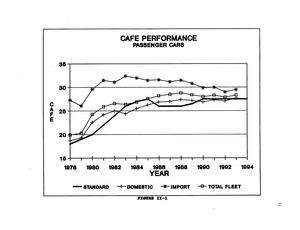
In MY 1993, the fleet average fuel economy for imported passenger
cars increased by 0.5 mpg from the MY 1992 CAFE level. Import CAFE was
29.5 mpg in MY 1993. Thirteen of the 18 imported car manufacturers
increased their CAFE values between MYs 1992 and 1993, including 6 of
the 9 Asian importers. Figure II-1 illustrates the changes in total new
passenger car fleet CAFE from MY 1978 to MY 1993.
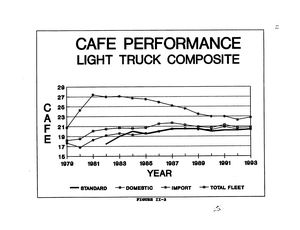
The total light truck fleet CAFE remained constant at the MY 1992
CAFE level of 20.8 mpg. Figure II-2 illustrates the progress in total
fleet CAFE from MY 1979 to MY 1993 for light trucks.
A number of passenger car and a few light truck manufacturers are
projected not to achieve the levels of the MY 1993 CAFE standards.
NHTSA is not yet able to determine which of these manufacturers may be
liable for civil penalties for noncompliance. Some MY 1993 CAFE values
may change when final figures are provided to NHTSA by EPA, in mid-
1994. In addition, several manufacturers are not expected to pay civil
penalties because the credits they earned by exceeding the fuel economy
standards in earlier years offset later shortfalls. Other manufacturers
may file carryback plans to demonstrate that they anticipate earning
credits in future model years to offset current deficits.
BILLING CODE 4910-59-M
 BILLING CODE 4910-59-C
Fleet average fuel economy for all MY 1993 passenger cars combined
and for all light trucks combined exceeded the levels of the MY 1993
standards.
Daihatsu terminated sales of its passenger cars and light trucks in
the United States after MY 1992, the first major Asian manufacturer to
do so. This manufacturer accumulated substantial CAFE credits during
its 5-year marketing span in the United States, but the sales of this
company's products reached such a low level that it apparently decided
it was economically infeasible to remain.
While one Asian manufacturer exited the United States market,
another, Kia Motors, entered. Kia, a South Korean manufacturer,
produces the Sephia sedan. It planned to test market a few thousand in
MY 1993, with sales slated for October 1993 at 50 dealerships. Kia
Motors also builds the Festiva model for Ford.
Mazda reported a domestic passenger car fleet consisting of its 626
and MX6 model vehicles which are built in Flatrock, Michigan. These
domestic-built vehicles do not appreciably affect the domestic fleet
CAFE.
The characteristics of the MY 1993 passenger car fleet reflect a
continuing trend toward increased consumer demand for higher
performance cars. (See Table II-3.) Compared to MY 1992, the average
curb weight for MY 1993 decreased 62 pounds for the domestic fleet and
decreased 14 pounds for the imported fleet. The total new car fleet is
36 pounds lighter than it was in MY 1992, primarily because of the
larger share held by the domestic fleet. From MY 1992 to MY 1993,
horsepower per/100 pounds, a measure of vehicle performance, increased
from 4.48 to 4.56 for domestic passenger cars and from 4.66 to 4.72 for
imported passenger cars. The total fleet average for passenger cars
increased from 4.56 in MY 1992 to 4.62 horsepower/100 pounds in MY
1993, the highest level in the 38 years for which the agency has data.
Average engine displacement decreased from 192 to 184 cubic inches for
domestic passenger cars and 139 to 136 cubic inches for imported
passenger cars.
The size class breakdown shows an increased trend towards compact
and midsize passenger cars and a decrease in subcompact and large
passenger cars for the overall fleet. The domestic fleet shift is
almost exclusively from subcompact and large passenger cars to compact
and midsize passenger cars. The shift of imported cars to both the
midsize and compact sizes is particularly pronounced. The imported
share of the passenger car market declined slightly in MY 1993, but
imported compact cars increased to 36.6 percent of the imported fleet
in MY 1993 from just 32.0 percent in MY 1992 and now make up nearly 15
percent of the total new passenger car fleet.
Table II-3.--Passenger Car Fleet Characteristics for MYs 1992 and 1993
----------------------------------------------------------------------------------------------------------------
Total fleet Domestic fleet Imported fleet
Characteristics -----------------------------------------------------------------------------
1992 1993 1992 1993 1992 1993
----------------------------------------------------------------------------------------------------------------
Fleet Average Fuel Economy, mpg... 27.9 28.3 27.1 27.7 29.0 29.5
Fleet Average Curb Weight, lbs.... 3007 2971 3108 3046 2875 2861
Fleet Average Engine Displacement,
cu. in........................... 169 164 192 184 139 136
Fleet Average Horsepower/Weight
ratio, HP/100 lbs................ 4.56 4.62 4.48 4.56 4.66 4.72
Percent of Fleet.............. 100 100 56.5 59.4 43.5 40.6
Segmentation by EPA Size Class,
percent:
Two-Seater........................ 1.0 1.4 0.4 0.5 1.6 2.8
Minicompact....................... 1.3 1.0 0.0 0.0 3.1 2.4
Subcompact*....................... 25.9 23.0 15.3 14.4 39.6 35.4
Compact*.......................... 29.6 33.7 27.7 31.7 32.0 36.6
Midsize*.......................... 27.0 29.4 35.8 37.8 15.6 17.2
Large*............................ 15.2 11.5 20.8 15.6 8.0 5.6
Percent Diesel Engines............ 0.06 0.04 0.0 0.0 0.14 0.09
Percent Turbo or Supercharged
Engines.......................... 2.4 1.1 2.9 0.5 1.9 1.9
Percent Fuel Injection............ 100 100 100 100 99.8 100
Percent Front-Wheel Drive......... 84.4 84.4 87.7 86.0 80.1 82.1
Percent Automatic Transmissions... 81.6 79.9 91.8 87.4 68.3 69.1
Percent Automatic Transmissions
with Lockup Clutches............. 92.6 93.1 92.8 93.3 92.3 92.6
Percent Automatic Transmissions
with Four or more Forward Speeds. 70.2 77.2 60.9 69.2 86.3 91.9
----------------------------------------------------------------------------------------------------------------
*Includes associated station wagons.
The 0.6 mpg fuel economy improvement for the MY 1993 domestic
passenger car fleet may be attributed to mix shifts and technology
changes in the following: significant changes in engine design,
decrease in average curb weight, and automatic transmissions with
lockup torque converters and four forward speeds.
The 0.5 mpg increase average fuel economy for the MY 1993 imported
passenger car fleet may be attributed to the same reasons as the
domestic fleet improvements.
The domestic fleet had a dramatic decrease in share of turbocharged
and supercharged engines. Diesel engines declined in share after a
small increase in MY 1992. Diesel engines were offered only on certain
Mercedes Benz models during MY 1993.
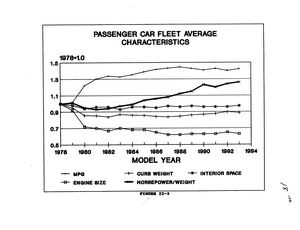
Passenger car fleet average characteristics have changed
significantly since the first year, MY 1978, of fuel economy standards.
After substantial initial weight loss from MY 1978 to MY 1982, the
average passenger car fleet curb weight decreased from 3,349 to 2,808
pounds; the passenger car fleet average curb weight stabilized at 2,800
to 3,000 pounds. Table II-4 shows that the MY 1993 passenger car fleet
has nearly equal interior volume, higher performance, but over 40
percent fuel economy improvement compared to the MY 1978 fleet (see
Figure II-3).
Table II-4.--New Passenger Car Fleet Average Characteristics
[Model Years 1978-1993]
----------------------------------------------------------------------------------------------------------------
Horsepower/
Model year Fuel economy Curb weight Interior space Engine size Weight (hp/100
(mpg) (lb.) (cu. ft.) (cu. in.) lb.)
----------------------------------------------------------------------------------------------------------------
1978............................ 19.9 3349 112 260 3.68
1979............................ 20.3 3180 110 238 3.72
1980............................ 24.3 2867 105 187 3.51
1981............................ 25.9 2883 108 182 3.43
1982............................ 26.6 2808 107 173 3.47
1983............................ 26.4 2908 109 182 3.57
1984............................ 26.9 2878 108 178 3.66
1985............................ 27.6 2867 108 177 3.84
1986............................ 28.2 2821 106 169 3.89
1987............................ 28.5 2805 109 162 3.98
1988............................ 28.8 2831 107 161 4.11
1989............................ 28.4 2879 109 163 4.24
1990............................ 28.0 2908 108 163 4.53
1991............................ 28.3 2934 108 164 4.42
1992............................ 27.9 3007 108 169 4.56
1993............................ 28.3 2971 109 164 4.62
----------------------------------------------------------------------------------------------------------------
BILLING CODE 4910-59-M
BILLING CODE 4910-59-C
Fleet average fuel economy for all MY 1993 passenger cars combined
and for all light trucks combined exceeded the levels of the MY 1993
standards.
Daihatsu terminated sales of its passenger cars and light trucks in
the United States after MY 1992, the first major Asian manufacturer to
do so. This manufacturer accumulated substantial CAFE credits during
its 5-year marketing span in the United States, but the sales of this
company's products reached such a low level that it apparently decided
it was economically infeasible to remain.
While one Asian manufacturer exited the United States market,
another, Kia Motors, entered. Kia, a South Korean manufacturer,
produces the Sephia sedan. It planned to test market a few thousand in
MY 1993, with sales slated for October 1993 at 50 dealerships. Kia
Motors also builds the Festiva model for Ford.
Mazda reported a domestic passenger car fleet consisting of its 626
and MX6 model vehicles which are built in Flatrock, Michigan. These
domestic-built vehicles do not appreciably affect the domestic fleet
CAFE.
The characteristics of the MY 1993 passenger car fleet reflect a
continuing trend toward increased consumer demand for higher
performance cars. (See Table II-3.) Compared to MY 1992, the average
curb weight for MY 1993 decreased 62 pounds for the domestic fleet and
decreased 14 pounds for the imported fleet. The total new car fleet is
36 pounds lighter than it was in MY 1992, primarily because of the
larger share held by the domestic fleet. From MY 1992 to MY 1993,
horsepower per/100 pounds, a measure of vehicle performance, increased
from 4.48 to 4.56 for domestic passenger cars and from 4.66 to 4.72 for
imported passenger cars. The total fleet average for passenger cars
increased from 4.56 in MY 1992 to 4.62 horsepower/100 pounds in MY
1993, the highest level in the 38 years for which the agency has data.
Average engine displacement decreased from 192 to 184 cubic inches for
domestic passenger cars and 139 to 136 cubic inches for imported
passenger cars.
The size class breakdown shows an increased trend towards compact
and midsize passenger cars and a decrease in subcompact and large
passenger cars for the overall fleet. The domestic fleet shift is
almost exclusively from subcompact and large passenger cars to compact
and midsize passenger cars. The shift of imported cars to both the
midsize and compact sizes is particularly pronounced. The imported
share of the passenger car market declined slightly in MY 1993, but
imported compact cars increased to 36.6 percent of the imported fleet
in MY 1993 from just 32.0 percent in MY 1992 and now make up nearly 15
percent of the total new passenger car fleet.
Table II-3.--Passenger Car Fleet Characteristics for MYs 1992 and 1993
----------------------------------------------------------------------------------------------------------------
Total fleet Domestic fleet Imported fleet
Characteristics -----------------------------------------------------------------------------
1992 1993 1992 1993 1992 1993
----------------------------------------------------------------------------------------------------------------
Fleet Average Fuel Economy, mpg... 27.9 28.3 27.1 27.7 29.0 29.5
Fleet Average Curb Weight, lbs.... 3007 2971 3108 3046 2875 2861
Fleet Average Engine Displacement,
cu. in........................... 169 164 192 184 139 136
Fleet Average Horsepower/Weight
ratio, HP/100 lbs................ 4.56 4.62 4.48 4.56 4.66 4.72
Percent of Fleet.............. 100 100 56.5 59.4 43.5 40.6
Segmentation by EPA Size Class,
percent:
Two-Seater........................ 1.0 1.4 0.4 0.5 1.6 2.8
Minicompact....................... 1.3 1.0 0.0 0.0 3.1 2.4
Subcompact*....................... 25.9 23.0 15.3 14.4 39.6 35.4
Compact*.......................... 29.6 33.7 27.7 31.7 32.0 36.6
Midsize*.......................... 27.0 29.4 35.8 37.8 15.6 17.2
Large*............................ 15.2 11.5 20.8 15.6 8.0 5.6
Percent Diesel Engines............ 0.06 0.04 0.0 0.0 0.14 0.09
Percent Turbo or Supercharged
Engines.......................... 2.4 1.1 2.9 0.5 1.9 1.9
Percent Fuel Injection............ 100 100 100 100 99.8 100
Percent Front-Wheel Drive......... 84.4 84.4 87.7 86.0 80.1 82.1
Percent Automatic Transmissions... 81.6 79.9 91.8 87.4 68.3 69.1
Percent Automatic Transmissions
with Lockup Clutches............. 92.6 93.1 92.8 93.3 92.3 92.6
Percent Automatic Transmissions
with Four or more Forward Speeds. 70.2 77.2 60.9 69.2 86.3 91.9
----------------------------------------------------------------------------------------------------------------
*Includes associated station wagons.
The 0.6 mpg fuel economy improvement for the MY 1993 domestic
passenger car fleet may be attributed to mix shifts and technology
changes in the following: significant changes in engine design,
decrease in average curb weight, and automatic transmissions with
lockup torque converters and four forward speeds.
The 0.5 mpg increase average fuel economy for the MY 1993 imported
passenger car fleet may be attributed to the same reasons as the
domestic fleet improvements.
The domestic fleet had a dramatic decrease in share of turbocharged
and supercharged engines. Diesel engines declined in share after a
small increase in MY 1992. Diesel engines were offered only on certain
Mercedes Benz models during MY 1993.
Passenger car fleet average characteristics have changed
significantly since the first year, MY 1978, of fuel economy standards.
After substantial initial weight loss from MY 1978 to MY 1982, the
average passenger car fleet curb weight decreased from 3,349 to 2,808
pounds; the passenger car fleet average curb weight stabilized at 2,800
to 3,000 pounds. Table II-4 shows that the MY 1993 passenger car fleet
has nearly equal interior volume, higher performance, but over 40
percent fuel economy improvement compared to the MY 1978 fleet (see
Figure II-3).
Table II-4.--New Passenger Car Fleet Average Characteristics
[Model Years 1978-1993]
----------------------------------------------------------------------------------------------------------------
Horsepower/
Model year Fuel economy Curb weight Interior space Engine size Weight (hp/100
(mpg) (lb.) (cu. ft.) (cu. in.) lb.)
----------------------------------------------------------------------------------------------------------------
1978............................ 19.9 3349 112 260 3.68
1979............................ 20.3 3180 110 238 3.72
1980............................ 24.3 2867 105 187 3.51
1981............................ 25.9 2883 108 182 3.43
1982............................ 26.6 2808 107 173 3.47
1983............................ 26.4 2908 109 182 3.57
1984............................ 26.9 2878 108 178 3.66
1985............................ 27.6 2867 108 177 3.84
1986............................ 28.2 2821 106 169 3.89
1987............................ 28.5 2805 109 162 3.98
1988............................ 28.8 2831 107 161 4.11
1989............................ 28.4 2879 109 163 4.24
1990............................ 28.0 2908 108 163 4.53
1991............................ 28.3 2934 108 164 4.42
1992............................ 27.9 3007 108 169 4.56
1993............................ 28.3 2971 109 164 4.62
----------------------------------------------------------------------------------------------------------------
BILLING CODE 4910-59-M
 BILLING CODE 4910-59-C
The passenger car fleet in MY 1993 averaged the highest horsepower-
to-weight ratio recorded since 1955, the earliest year for which NHTSA
has data.
The characteristics of the MY 1993 light truck fleet are shown in
Table II-5. Since light truck manufacturers are not required to divide
their fleets into domestic and import fleets based on the 75 percent
domestic content threshold used for passenger car fleets (except for
United States-based manufacturers with captive import fleets), the
domestic and imported fleet characteristics in Table II-5 are
estimated. NHTSA assumed foreign-based manufacturer's products would
not meet the domestic content threshold, whether they were assembled in
the United States, Canada, or another country. The exception is the
assumption that the import-badged products of a domestic manufacturer's
assembled plant were ``domestic'' (Mazda Navajo and Nissan Quest).
Table II-5.--Light Truck Fleet Characteristics for MYs 1992 and 1993
----------------------------------------------------------------------------------------------------------------
Total fleet Domestic fleet Imported fleet
Characteristics -----------------------------------------------------------------------------
1992 1993 1992 1993 1992 1993
----------------------------------------------------------------------------------------------------------------
Fleet Average Fuel Economy, mpg... 20.8 20.8 20.5 20.5 22.5 22.8
Fleet Average Equivalent Test
Weight, lbs...................... 4169 4201 4260 4284 3733 3727
Fleet average Engine Displacement,
cu. in........................... 235 237 251 249 160 167
Fleet Average Horsepower/Weight
Ratio, HP/100 lbs................ 3.92 3.89 4.02 3.97 3.46 3.47
Percent of Fleet.............. 100 100 82.7 85.1 17.3 14.9
Segmentation by Type, percent:
Passenger Van:
Compact................... 21.4 23.6 23.1 25.8 12.9 11.1
Large..................... 0.6 0.3 0.7 0.4 ........... ...........
Cargo Van:
Compact................... 1.7 1.4 2.1 1.6 ........... ...........
Large..................... 5.4 4.7 6.5 5.6 ........... ...........
Small Pickup*................. 14.2 7.9 13.8 6.6 16.6 15.7
Large Pickup*................. 31.3 34.2 30.5 33.4 35.3 39.2
Special Purpose............... 25.4 27.8 23.4 26.7 35.3 33.9
Percent Diesel Engines........ 0.09 0.07 0.11 0.09 ........... ...........
Percent Fuel Injection........ 98.9 99.0 100 100 93.5 93.0
Percent Automatic
Transmissions................ 72.2 76.2 78.9 82.5 40.3 39.9
Percent Automatic
Transmissions with Lockup
Clutches..................... 98.1 98.6 98.8 99.1 91.2 92.3
Percent Automatic
Transmissions with Four
Forward Speeds............... 88.6 90.5 87.8 89.9 96.5 97.1
Percent 4-Wheel Drive......... 32.8 33.7 29.9 32.3 47.1 41.2
----------------------------------------------------------------------------------------------------------------
*Including Cab Chassis.
The average test weight of the total light truck fleet increased by
32 pounds over that for MY 1992. The stability of the 20.8 mpg CAFE
level between MYs 1992 and 1993 may be attributed to the small increase
in shares of compact vans and special purpose vehicles and the small
increase in the use of lockup converter clutches and four forward speed
automatic transmissions, offsetting the increased popularity of large
pickups and heavier trucks. Diesel engine usage declined in light
trucks to 0.07 percent in MY 1993 from 0.09 percent in MY 1992. The
imported share of the MY 1993 light truck fleet decreased to 14.9
percent, 2.4 percent lower than MY 1992 and the lowest share since
light truck fuel economy standards were established.
During MYs 1980 through 1993, CAFE levels for light trucks in the
0-8,500 pounds gross vehicle weight (GVW) class increased, beginning at
18.5 mpg in MY 1980 and reaching 21.7 mpg in MY 1987 before dropping to
lower values in MY 1988 through MY 1993, as average weight, engine
size, and performance increased. During these years, light truck
production increased from 1.9 million in MY 1980 to 4.6 million in MY
1993. Light trucks comprised nearly a third of the total light duty
vehicle fleet production in MY 1993, almost double its share in MY
1980.
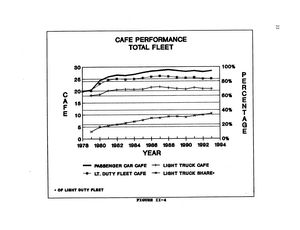
Figure II-4 illustrates that the light duty fleet (passenger cars
and light trucks together) average fuel economy steadily increased in
MY 1987, but subsequently has been below the MY 1987 level (see Table
II-6). Light truck average fuel economy also declined, but the
passenger car average fuel economy remained relatively constant for MYs
1987-1993. The overall decline illustrates the emergence of light
trucks in the light duty fleet.
BILLING CODE 4910-59-M
BILLING CODE 4910-59-C
The passenger car fleet in MY 1993 averaged the highest horsepower-
to-weight ratio recorded since 1955, the earliest year for which NHTSA
has data.
The characteristics of the MY 1993 light truck fleet are shown in
Table II-5. Since light truck manufacturers are not required to divide
their fleets into domestic and import fleets based on the 75 percent
domestic content threshold used for passenger car fleets (except for
United States-based manufacturers with captive import fleets), the
domestic and imported fleet characteristics in Table II-5 are
estimated. NHTSA assumed foreign-based manufacturer's products would
not meet the domestic content threshold, whether they were assembled in
the United States, Canada, or another country. The exception is the
assumption that the import-badged products of a domestic manufacturer's
assembled plant were ``domestic'' (Mazda Navajo and Nissan Quest).
Table II-5.--Light Truck Fleet Characteristics for MYs 1992 and 1993
----------------------------------------------------------------------------------------------------------------
Total fleet Domestic fleet Imported fleet
Characteristics -----------------------------------------------------------------------------
1992 1993 1992 1993 1992 1993
----------------------------------------------------------------------------------------------------------------
Fleet Average Fuel Economy, mpg... 20.8 20.8 20.5 20.5 22.5 22.8
Fleet Average Equivalent Test
Weight, lbs...................... 4169 4201 4260 4284 3733 3727
Fleet average Engine Displacement,
cu. in........................... 235 237 251 249 160 167
Fleet Average Horsepower/Weight
Ratio, HP/100 lbs................ 3.92 3.89 4.02 3.97 3.46 3.47
Percent of Fleet.............. 100 100 82.7 85.1 17.3 14.9
Segmentation by Type, percent:
Passenger Van:
Compact................... 21.4 23.6 23.1 25.8 12.9 11.1
Large..................... 0.6 0.3 0.7 0.4 ........... ...........
Cargo Van:
Compact................... 1.7 1.4 2.1 1.6 ........... ...........
Large..................... 5.4 4.7 6.5 5.6 ........... ...........
Small Pickup*................. 14.2 7.9 13.8 6.6 16.6 15.7
Large Pickup*................. 31.3 34.2 30.5 33.4 35.3 39.2
Special Purpose............... 25.4 27.8 23.4 26.7 35.3 33.9
Percent Diesel Engines........ 0.09 0.07 0.11 0.09 ........... ...........
Percent Fuel Injection........ 98.9 99.0 100 100 93.5 93.0
Percent Automatic
Transmissions................ 72.2 76.2 78.9 82.5 40.3 39.9
Percent Automatic
Transmissions with Lockup
Clutches..................... 98.1 98.6 98.8 99.1 91.2 92.3
Percent Automatic
Transmissions with Four
Forward Speeds............... 88.6 90.5 87.8 89.9 96.5 97.1
Percent 4-Wheel Drive......... 32.8 33.7 29.9 32.3 47.1 41.2
----------------------------------------------------------------------------------------------------------------
*Including Cab Chassis.
The average test weight of the total light truck fleet increased by
32 pounds over that for MY 1992. The stability of the 20.8 mpg CAFE
level between MYs 1992 and 1993 may be attributed to the small increase
in shares of compact vans and special purpose vehicles and the small
increase in the use of lockup converter clutches and four forward speed
automatic transmissions, offsetting the increased popularity of large
pickups and heavier trucks. Diesel engine usage declined in light
trucks to 0.07 percent in MY 1993 from 0.09 percent in MY 1992. The
imported share of the MY 1993 light truck fleet decreased to 14.9
percent, 2.4 percent lower than MY 1992 and the lowest share since
light truck fuel economy standards were established.
During MYs 1980 through 1993, CAFE levels for light trucks in the
0-8,500 pounds gross vehicle weight (GVW) class increased, beginning at
18.5 mpg in MY 1980 and reaching 21.7 mpg in MY 1987 before dropping to
lower values in MY 1988 through MY 1993, as average weight, engine
size, and performance increased. During these years, light truck
production increased from 1.9 million in MY 1980 to 4.6 million in MY
1993. Light trucks comprised nearly a third of the total light duty
vehicle fleet production in MY 1993, almost double its share in MY
1980.
Figure II-4 illustrates that the light duty fleet (passenger cars
and light trucks together) average fuel economy steadily increased in
MY 1987, but subsequently has been below the MY 1987 level (see Table
II-6). Light truck average fuel economy also declined, but the
passenger car average fuel economy remained relatively constant for MYs
1987-1993. The overall decline illustrates the emergence of light
trucks in the light duty fleet.
BILLING CODE 4910-59-M
 BILLING CODE 4910-59-C
Table II-6.--Domestic and Imported Passenger Car and Light Truck Fuel Economy Averages For Model Years 1978-1993
[In MPG]
----------------------------------------------------------------------------------------------------------------
Domestic Imported
------------------------------------------------------------------------------ Total fleet
Model year Light truck
Car Combined Car Light truck Combined
----------------------------------------------------------------------------------------------------------------
1978................. 18.7 ........... ........... 27.3 ........... ........... ...........
1979................. 19.3 17.7 19.1 26.1 20.8 25.5 20.1
1980................. 22.6 16.8 21.4 29.6 24.3 28.6 23.1
1981................. 24.2 18.3 22.9 31.5 27.4 30.7 24.6
1982................. 25.0 19.2 23.5 31.1 27.0 30.4 25.0
1983................. 24.4 19.6 23.0 32.4 27.1 31.5 24.8
1984................. 25.5 19.3 23.6 32.0 26.7 30.6 25.0
1985................. 26.3 19.6 24.0 31.5 26.5 30.3 25.4
1986................. 26.9 20.0 24.4 31.6 25.9 29.8 25.9
1987................. 27.0 20.5 24.6 31.2 25.2 29.6 26.2
1988................. 27.4 20.6 24.5 31.5 24.6 30.0 26.0
1989................. 27.2 20.4 24.2 30.8 23.5 29.2 25.6
1990................. 26.9 20.3 23.9 29.9 23.0 28.5 25.4
1991................. 27.3 20.9 24.4 30.0 23.0 28.3 25.6
1992................. 27.1 20.5 23.9 29.0 22.5 27.6 25.0
1993................. 27.7 20.5 23.8 29.5 22.8 28.0 25.1
----------------------------------------------------------------------------------------------------------------
While the passenger car fleet fuel economy improved by 0.4 mpg from
MY 1992 to MY 1993 and the light truck fleet was unchanged, the total
fleet fuel economy for MY 1993 increased only 0.1 mpg over the MY 1992
level (25.0 mpg for MY 1992 and 25.1 mpg for MY 1993). This is
attributed to increased sales of light trucks which have a total fleet
fuel economy far less than passenger cars. The shift to light trucks
for general transportation is an important trend in consumers'
preference and has a significant fleet fuel consumption effect.
Domestic and imported passenger car fleet average fuel economies
improved since MY 1978. In MY 1993, the domestic and imported passenger
car fleet average fuel economies increased to 27.7 mpg and 29.5 mpg,
respectively. This reflects an increase of 9.0 mpg since MY 1978 for
domestic cars. For imported cars, the MY 1993 average fuel economy is
only 2.2 mpg higher than that of MY 1978.
Domestic and imported light truck fleet average fuel economies
improved since MY 1980. The domestic manufacturers continued to
dominate the light truck market. Domestic light trucks comprised 85.1
percent of the total light truck fleet. For MY 1993, the domestic light
truck fleet has an average fuel economy of 2.3 mpg lower than the
imported light truck fleet. The imported light truck fleet fuel economy
improved rapidly between MYs 1980 and 1981, but has been lower since
then. For MY 1993, the imported light truck fleet fuel economy
increased 0.3 mpg over MY 1992 to 22.8 mpg. A comparison of MYs 1993 to
1980 was done to avoid comparing the performance of the 0-6,000 pounds
GVWR light truck fleet covered by the MY 1979 fuel economy standard to
the performance of the 0-8,500 pounds GVWR fleets to which the
standards apply for MY 1980 and beyond.
The gap between the average CAFEs of the imported and domestic
manufacturers is smaller than in earlier years as domestic
manufacturers maintain relatively stable CAFE values while the import
manufacturers move to larger, higher performance vehicles and more
four-wheel drive light trucks.
Based on a comparative analysis, since the enactment of CAFE
standards for passenger cars for MY 1978, the total annual fleet fuel
consumption, for both passenger cars and light trucks, has grown from
105.7 billion gallons (81.7 billion gallons for passenger cars + 24.1
billion gallons for 2-axle, 4-tire light trucks) in 1978 (Highway
Statistics Summary to 1985, Table VM-201A) to 107 billion gallons (73.9
billion gallons for passenger cars + 33.1 billion gallons for light
trucks) in 1992, the most current data (Highway Statistics Summary to
1992, Table VM-1). Over a 14-year period, total fuel consumption
increased only 1.2 percent. Improvements in fuel economy have offset
growth in the total number of light duty vehicles and in miles traveled
per vehicle.
Both vehicle registrations and vehicle miles traveled increased
from 1978 to 1992. The total fleet registration increased 27.7 percent
from 143,904,787 (118,428,730 for passenger cars + 25,476,057 for light
trucks) in 1978 to 183,746,571 (144,213,429 for passenger cars +
39,533,142 for light trucks) in MY 1992. Vehicle miles traveled
increased during this period. In 1978, vehicle miles traveled totaled
1.426 trillion (1.147 for passenger cars + 0.279 for light trucks). It
increased to 2.072 trillion for the total fleet (1.595 for passenger
cars + 0.477 for light trucks) in 1992. This is an increase of over
45.3 percent.
In conclusion, although more vehicles are traveling more miles,
fuel consumption by this total fleet (both passenger cars and light
trucks) has increased only slightly.
Section III: 1993 Activities
A. Passenger Car CAFE Standards
The following synopsis describes litigation challenging NHTSA
actions under the CAFE program.
Competitive Enterprise Institute (CEI) v. NHTSA, D.C. Circuit Court,
No. 89-1422
This case challenged NHTSA's May 1989 decision to terminate
rulemaking on whether to amend the MY 1990 passenger car CAFE standard.
On February 19, 1992, in a 2-1 decision, the D.C. Circuit Court held
that NHTSA failed to adequately evaluate the safety consequences of its
decision to retain the MY 1990 passenger car CAFE standard of 27.5 mpg
rather than proceeding with proposed rulemaking to reduce that model
year's standard. The Court remanded the matter to NHTSA for further
consideration. CEI filed a Motion for Attorney Fees which NHTSA
opposed. On August 6, 1992, the Court issued an order deferring
decision on CEI's fee motion until NHTSA acts on the Court's remand
order. NHTSA's subsequent action on this remand order is discussed
below.
Competitive Enterprise Institute v. NHTSA, D.C. Circuit Court, No. 93-
1210
This case challenges NHTSA's January 15, 1993, decision (D.C.
Circuit Court's remand in Case No. 89-1422) to again terminate the
rulemaking it commenced to consider amending the MY 1990 passenger car
CAFE standard. The petition for review was filed on March 15, 1993.
Both sides filed preliminary papers, but the Court has not yet issued a
briefing and argument schedule.
B. Light Truck CAFE Standards
NHTSA published a final rule establishing the MY 1995 light truck
fuel economy standard on April 7, 1993 (58 FR 18019). NHTSA set a
combined standard of 20.6 mpg for MY 1995, the highest CAFE standard
the agency has ever established for light trucks. The rule also
converted certain measurements into metric units, the agency's first
occurrence of using metric conversion for regulations relating to fuel
economy standards.
In the final rule for MY 1995 light trucks, NHTSA determined that
GM is the ``least capable'' manufacturer with a combined fuel economy
capability of 20.6 mpg.
NHTSA concluded upon balancing the relevant statutory factors, that
the relatively small and uncertain energy savings that would be
associated with setting a standard above GM's capability would not
justify the economic harm to the company and the economy as a whole.
NHTSA projected that GM could not achieve a combined fuel economy level
higher than 20.6 mpg for MY 1995. In contrast, NHTSA concluded that
Chrysler and Ford can achieve CAFE levels of at least 20.6 mpg.
NHTSA selected 20.6 mpg for MY 1995 as the final combined standard
to balance the potentially serious adverse economic consequences
associated with the realization of the above market and technological
risks against GM's opportunity as the ``least capable'' manufacturer
with a substantial share of sales. Since GM produces more than 38
percent of all light trucks that are subject to the fuel economy
standards, its capability significantly affects the level of the
industry's capability and, therefore, the standard level.
A final rule for light truck fuel economy standards for MYs 1996
and 1997 is pending.
C. Low Volume Petitions
Section 502(c) of the Act provides that a low volume manufacturer
of passenger cars may be exempted from the generally applicable
passenger car fuel economy standards if these standards are more
stringent than the maximum feasible average fuel economy for that
manufacturer and if NHTSA establishes an alternative standard for that
manufacturer at its maximum feasible level. Under the Act, a low volume
manufacturer is one that manufactured fewer than 10,000 passenger cars
worldwide, in the model year for which the exemption is sought (the
affected model year) and in the second model year preceding that model
year.
During 1993, NHTSA acted on one low volume petition that was filed
by Rolls-Royce. Rolls-Royce requested an alternative standard for its
passenger cars for MYs 1995 and 1996. NHTSA issued a proposed decision
to grant an alternative standard of 14.6 mpg for both model years (58
FR 41228 August 3, 1993).
D. Enforcement
Section 508(b)(1) of the Act imposes a civil penalty of $5 dollars
for each tenth of a mpg by which a manufacturer's CAFE level falls
short of the standard, multiplied by the total number of passenger
automobiles or light trucks produced by the manufacturer in that model
year. Credits that were earned for exceeding the standard in any of the
three model years immediately prior to or subsequent to the model years
in question can be used to offset the penalty.
With EPA completion of final CAFE computations for MY 1992 for most
passenger car fleets, NHTSA initiated enforcement actions for
manufacturers that did not meet the CAFE standard.
Table III-1 shows the most recent CAFE fines paid by manufacturers.
Table III-1.--CAFE Fines Collected During Fiscal Year 1993
------------------------------------------------------------------------
Amount
Model year Manufacturer fined Date paid
------------------------------------------------------------------------
1989...... Sterling.......................... $588,195 07/93
1990...... Fiat.............................. 705,220 05/93
Sterling.......................... 162,000 07/93
Fiat.............................. 796,575 05/93
Mercedes-Benz..................... 19,169,540 12/93
1991...... Peugeot........................... 192,660 12/92
Vector............................ 1,740 07/93
Volvo............................. 7,768,420 12/92
1992...... Fiat.............................. 466,750 05/93
Peugeot........................... 58,375 09/93
------------------------------------------------------------------------
The following synopsis describes an administrative adjudication
involving NHTSA action under the CAFE program that is pending.
Chrysler Corporation, Docket 47414
On January 8, 1992, an Administrative Law Judge issued an initial
decision and order recommending that NHTSA's complaint seeking a civil
penalty of $1,371,420 for Chrysler's failure to comply with the MY 1984
domestic light truck fuel economy standard be dismissed without
prejudice. He concluded that NHTSA could not interpret the extent to
which predecessors or successors are included in the term
``manufacturer'' without issuing rules pursuant to section 501(8) of
the Motor Vehicle Information and Cost Savings Act of 1972, but that
Chrysler could not claim credits earned by American Motor Corporation,
except under the terms of a properly adopted rule. Both parties filed
Notices of Intention to appeal the initial decision to NHTSA's
Administrator. On March 31, 1992, after a meeting to consider
settlement proposals, the Administrator set aside the initial decision
and terminated the enforcement proceeding, without prejudice, to permit
NHTSA to prescribe regulations pursuant to section 501(8) of the Act.
Section IV: Use of Advanced Technology
This section fulfills the statutory requirement of Title III of the
Department of Energy Act (15 U.S.C. 2704 et seq.) which directs the
Secretary of Transportation to submit an annual report to Congress on
the use of advanced technologies by the automotive industry to improve
motor vehicle fuel economy. This report focuses on the introduction of
new models, the application of materials to save weight, and the
advances in electronic technology which improved fuel economy in MY
1993.
A. New Models
I. Passenger Cars
a. Domestic. The domestic manufacturers introduced and replaced
several cars, as well as updated several previous passenger cars.
Chrysler unveiled its new midsize LH models--the Chrysler Concorde,
Dodge Intrepid, and Eagle Vision. These models are built on the new
front-drive LH platform, the company's first new platform in 10 years.
The main features included advanced technology, roomy interior, ride
comfort, handling precision, safety, fuel economy, and power. The LH
models' longitudinally mounted engines include a 153 horsepower (hp)
overhead-valve (OHV) 3.3 liter (1) V-6 and a 214 hp single-overhead-cam
(SOHC) 3.5L 24-valve V-6 (standard on some models, optional on others)
developed especially for the LH line. Both engines are mated to only
one transaxle: the 42LE automatic, a fully adaptive electronically
controlled four-speed with torque converter lockup clutch. The low drag
coefficient (0.31 C
BILLING CODE 4910-59-C
Table II-6.--Domestic and Imported Passenger Car and Light Truck Fuel Economy Averages For Model Years 1978-1993
[In MPG]
----------------------------------------------------------------------------------------------------------------
Domestic Imported
------------------------------------------------------------------------------ Total fleet
Model year Light truck
Car Combined Car Light truck Combined
----------------------------------------------------------------------------------------------------------------
1978................. 18.7 ........... ........... 27.3 ........... ........... ...........
1979................. 19.3 17.7 19.1 26.1 20.8 25.5 20.1
1980................. 22.6 16.8 21.4 29.6 24.3 28.6 23.1
1981................. 24.2 18.3 22.9 31.5 27.4 30.7 24.6
1982................. 25.0 19.2 23.5 31.1 27.0 30.4 25.0
1983................. 24.4 19.6 23.0 32.4 27.1 31.5 24.8
1984................. 25.5 19.3 23.6 32.0 26.7 30.6 25.0
1985................. 26.3 19.6 24.0 31.5 26.5 30.3 25.4
1986................. 26.9 20.0 24.4 31.6 25.9 29.8 25.9
1987................. 27.0 20.5 24.6 31.2 25.2 29.6 26.2
1988................. 27.4 20.6 24.5 31.5 24.6 30.0 26.0
1989................. 27.2 20.4 24.2 30.8 23.5 29.2 25.6
1990................. 26.9 20.3 23.9 29.9 23.0 28.5 25.4
1991................. 27.3 20.9 24.4 30.0 23.0 28.3 25.6
1992................. 27.1 20.5 23.9 29.0 22.5 27.6 25.0
1993................. 27.7 20.5 23.8 29.5 22.8 28.0 25.1
----------------------------------------------------------------------------------------------------------------
While the passenger car fleet fuel economy improved by 0.4 mpg from
MY 1992 to MY 1993 and the light truck fleet was unchanged, the total
fleet fuel economy for MY 1993 increased only 0.1 mpg over the MY 1992
level (25.0 mpg for MY 1992 and 25.1 mpg for MY 1993). This is
attributed to increased sales of light trucks which have a total fleet
fuel economy far less than passenger cars. The shift to light trucks
for general transportation is an important trend in consumers'
preference and has a significant fleet fuel consumption effect.
Domestic and imported passenger car fleet average fuel economies
improved since MY 1978. In MY 1993, the domestic and imported passenger
car fleet average fuel economies increased to 27.7 mpg and 29.5 mpg,
respectively. This reflects an increase of 9.0 mpg since MY 1978 for
domestic cars. For imported cars, the MY 1993 average fuel economy is
only 2.2 mpg higher than that of MY 1978.
Domestic and imported light truck fleet average fuel economies
improved since MY 1980. The domestic manufacturers continued to
dominate the light truck market. Domestic light trucks comprised 85.1
percent of the total light truck fleet. For MY 1993, the domestic light
truck fleet has an average fuel economy of 2.3 mpg lower than the
imported light truck fleet. The imported light truck fleet fuel economy
improved rapidly between MYs 1980 and 1981, but has been lower since
then. For MY 1993, the imported light truck fleet fuel economy
increased 0.3 mpg over MY 1992 to 22.8 mpg. A comparison of MYs 1993 to
1980 was done to avoid comparing the performance of the 0-6,000 pounds
GVWR light truck fleet covered by the MY 1979 fuel economy standard to
the performance of the 0-8,500 pounds GVWR fleets to which the
standards apply for MY 1980 and beyond.
The gap between the average CAFEs of the imported and domestic
manufacturers is smaller than in earlier years as domestic
manufacturers maintain relatively stable CAFE values while the import
manufacturers move to larger, higher performance vehicles and more
four-wheel drive light trucks.
Based on a comparative analysis, since the enactment of CAFE
standards for passenger cars for MY 1978, the total annual fleet fuel
consumption, for both passenger cars and light trucks, has grown from
105.7 billion gallons (81.7 billion gallons for passenger cars + 24.1
billion gallons for 2-axle, 4-tire light trucks) in 1978 (Highway
Statistics Summary to 1985, Table VM-201A) to 107 billion gallons (73.9
billion gallons for passenger cars + 33.1 billion gallons for light
trucks) in 1992, the most current data (Highway Statistics Summary to
1992, Table VM-1). Over a 14-year period, total fuel consumption
increased only 1.2 percent. Improvements in fuel economy have offset
growth in the total number of light duty vehicles and in miles traveled
per vehicle.
Both vehicle registrations and vehicle miles traveled increased
from 1978 to 1992. The total fleet registration increased 27.7 percent
from 143,904,787 (118,428,730 for passenger cars + 25,476,057 for light
trucks) in 1978 to 183,746,571 (144,213,429 for passenger cars +
39,533,142 for light trucks) in MY 1992. Vehicle miles traveled
increased during this period. In 1978, vehicle miles traveled totaled
1.426 trillion (1.147 for passenger cars + 0.279 for light trucks). It
increased to 2.072 trillion for the total fleet (1.595 for passenger
cars + 0.477 for light trucks) in 1992. This is an increase of over
45.3 percent.
In conclusion, although more vehicles are traveling more miles,
fuel consumption by this total fleet (both passenger cars and light
trucks) has increased only slightly.
Section III: 1993 Activities
A. Passenger Car CAFE Standards
The following synopsis describes litigation challenging NHTSA
actions under the CAFE program.
Competitive Enterprise Institute (CEI) v. NHTSA, D.C. Circuit Court,
No. 89-1422
This case challenged NHTSA's May 1989 decision to terminate
rulemaking on whether to amend the MY 1990 passenger car CAFE standard.
On February 19, 1992, in a 2-1 decision, the D.C. Circuit Court held
that NHTSA failed to adequately evaluate the safety consequences of its
decision to retain the MY 1990 passenger car CAFE standard of 27.5 mpg
rather than proceeding with proposed rulemaking to reduce that model
year's standard. The Court remanded the matter to NHTSA for further
consideration. CEI filed a Motion for Attorney Fees which NHTSA
opposed. On August 6, 1992, the Court issued an order deferring
decision on CEI's fee motion until NHTSA acts on the Court's remand
order. NHTSA's subsequent action on this remand order is discussed
below.
Competitive Enterprise Institute v. NHTSA, D.C. Circuit Court, No. 93-
1210
This case challenges NHTSA's January 15, 1993, decision (D.C.
Circuit Court's remand in Case No. 89-1422) to again terminate the
rulemaking it commenced to consider amending the MY 1990 passenger car
CAFE standard. The petition for review was filed on March 15, 1993.
Both sides filed preliminary papers, but the Court has not yet issued a
briefing and argument schedule.
B. Light Truck CAFE Standards
NHTSA published a final rule establishing the MY 1995 light truck
fuel economy standard on April 7, 1993 (58 FR 18019). NHTSA set a
combined standard of 20.6 mpg for MY 1995, the highest CAFE standard
the agency has ever established for light trucks. The rule also
converted certain measurements into metric units, the agency's first
occurrence of using metric conversion for regulations relating to fuel
economy standards.
In the final rule for MY 1995 light trucks, NHTSA determined that
GM is the ``least capable'' manufacturer with a combined fuel economy
capability of 20.6 mpg.
NHTSA concluded upon balancing the relevant statutory factors, that
the relatively small and uncertain energy savings that would be
associated with setting a standard above GM's capability would not
justify the economic harm to the company and the economy as a whole.
NHTSA projected that GM could not achieve a combined fuel economy level
higher than 20.6 mpg for MY 1995. In contrast, NHTSA concluded that
Chrysler and Ford can achieve CAFE levels of at least 20.6 mpg.
NHTSA selected 20.6 mpg for MY 1995 as the final combined standard
to balance the potentially serious adverse economic consequences
associated with the realization of the above market and technological
risks against GM's opportunity as the ``least capable'' manufacturer
with a substantial share of sales. Since GM produces more than 38
percent of all light trucks that are subject to the fuel economy
standards, its capability significantly affects the level of the
industry's capability and, therefore, the standard level.
A final rule for light truck fuel economy standards for MYs 1996
and 1997 is pending.
C. Low Volume Petitions
Section 502(c) of the Act provides that a low volume manufacturer
of passenger cars may be exempted from the generally applicable
passenger car fuel economy standards if these standards are more
stringent than the maximum feasible average fuel economy for that
manufacturer and if NHTSA establishes an alternative standard for that
manufacturer at its maximum feasible level. Under the Act, a low volume
manufacturer is one that manufactured fewer than 10,000 passenger cars
worldwide, in the model year for which the exemption is sought (the
affected model year) and in the second model year preceding that model
year.
During 1993, NHTSA acted on one low volume petition that was filed
by Rolls-Royce. Rolls-Royce requested an alternative standard for its
passenger cars for MYs 1995 and 1996. NHTSA issued a proposed decision
to grant an alternative standard of 14.6 mpg for both model years (58
FR 41228 August 3, 1993).
D. Enforcement
Section 508(b)(1) of the Act imposes a civil penalty of $5 dollars
for each tenth of a mpg by which a manufacturer's CAFE level falls
short of the standard, multiplied by the total number of passenger
automobiles or light trucks produced by the manufacturer in that model
year. Credits that were earned for exceeding the standard in any of the
three model years immediately prior to or subsequent to the model years
in question can be used to offset the penalty.
With EPA completion of final CAFE computations for MY 1992 for most
passenger car fleets, NHTSA initiated enforcement actions for
manufacturers that did not meet the CAFE standard.
Table III-1 shows the most recent CAFE fines paid by manufacturers.
Table III-1.--CAFE Fines Collected During Fiscal Year 1993
------------------------------------------------------------------------
Amount
Model year Manufacturer fined Date paid
------------------------------------------------------------------------
1989...... Sterling.......................... $588,195 07/93
1990...... Fiat.............................. 705,220 05/93
Sterling.......................... 162,000 07/93
Fiat.............................. 796,575 05/93
Mercedes-Benz..................... 19,169,540 12/93
1991...... Peugeot........................... 192,660 12/92
Vector............................ 1,740 07/93
Volvo............................. 7,768,420 12/92
1992...... Fiat.............................. 466,750 05/93
Peugeot........................... 58,375 09/93
------------------------------------------------------------------------
The following synopsis describes an administrative adjudication
involving NHTSA action under the CAFE program that is pending.
Chrysler Corporation, Docket 47414
On January 8, 1992, an Administrative Law Judge issued an initial
decision and order recommending that NHTSA's complaint seeking a civil
penalty of $1,371,420 for Chrysler's failure to comply with the MY 1984
domestic light truck fuel economy standard be dismissed without
prejudice. He concluded that NHTSA could not interpret the extent to
which predecessors or successors are included in the term
``manufacturer'' without issuing rules pursuant to section 501(8) of
the Motor Vehicle Information and Cost Savings Act of 1972, but that
Chrysler could not claim credits earned by American Motor Corporation,
except under the terms of a properly adopted rule. Both parties filed
Notices of Intention to appeal the initial decision to NHTSA's
Administrator. On March 31, 1992, after a meeting to consider
settlement proposals, the Administrator set aside the initial decision
and terminated the enforcement proceeding, without prejudice, to permit
NHTSA to prescribe regulations pursuant to section 501(8) of the Act.
Section IV: Use of Advanced Technology
This section fulfills the statutory requirement of Title III of the
Department of Energy Act (15 U.S.C. 2704 et seq.) which directs the
Secretary of Transportation to submit an annual report to Congress on
the use of advanced technologies by the automotive industry to improve
motor vehicle fuel economy. This report focuses on the introduction of
new models, the application of materials to save weight, and the
advances in electronic technology which improved fuel economy in MY
1993.
A. New Models
I. Passenger Cars
a. Domestic. The domestic manufacturers introduced and replaced
several cars, as well as updated several previous passenger cars.
Chrysler unveiled its new midsize LH models--the Chrysler Concorde,
Dodge Intrepid, and Eagle Vision. These models are built on the new
front-drive LH platform, the company's first new platform in 10 years.
The main features included advanced technology, roomy interior, ride
comfort, handling precision, safety, fuel economy, and power. The LH
models' longitudinally mounted engines include a 153 horsepower (hp)
overhead-valve (OHV) 3.3 liter (1) V-6 and a 214 hp single-overhead-cam
(SOHC) 3.5L 24-valve V-6 (standard on some models, optional on others)
developed especially for the LH line. Both engines are mated to only
one transaxle: the 42LE automatic, a fully adaptive electronically
controlled four-speed with torque converter lockup clutch. The low drag
coefficient (0.31 CD) of these models contributed to their fuel
efficiency which averaged 24 mpg for MY 1993.
Also new to the Chrysler Eagle Talon, is a smaller 1.8L I-4 engine
offered with either 5-speed manual or 4-speed automatic transmission
and delivering an average fuel economy of 27 mpg.
The Plymouth Division offered a redesigned Colt coupe and sedan and
Vista wagon with a new 1.8L 16 valve SOHC engine that produces 113 hp
and a 2.4L 16 valve SOHC engine on the Vista only that produces 136 hp.
The average fuel economy on the Colt's 1.5L 4-cylinder engine with a 5-
speed manual transmission increased by 3 mpg city and 5 mpg highway
over its MY 1992 counterpart.
Ford has two new models--the Lincoln Mark VIII sport luxury coupe
and the Mercury Villager minivan (the latter is discussed later with
the light trucks). The Mark VIII features an aerodynamic design style
powered by a new aluminum double-overhead-cam (DOHC) V-8 engine and a
new Ford ``4R70W'' 4-speed automatic transmission. The ``4R70W'' stands
for 4-speed, rear-drive, 700 pound-feet torque capacity and wide ratio.
The transmission's electronic and hydraulic controls work together to
provide smooth shifts and torque-converter lock-up in third and fourth
gear. This reduces the converter slippage and improves the fuel
economy. The average fuel economy on this model is nearly 24 mpg
compared with 22.3 mpg for the predecessor Mark VII model.
Ford redesigned the 2-door Probe for MY 1993 based on Mazda's
latest MX-6. The Probe has a cab forward design and is powered by
multivalve engines. The base model is equipped with a 115 hp 2L, 4-
cylinder engine and the GT is powered by a 165 hp 2.5L V-6 engine. The
average fuel economy on the 5-speed manual transmission has improved by
2 mpg over the MY 1992 model.
The limited-edition Ford Mustang Cobra specialty model featured a
230 hp version of the Mustang's 5L V-8 engine, a 5-speed manual
transmission, 17-inch aluminum wheels, a spoiler, and ground effects
trim. The average fuel economy improved by 1 mpg on the 4-speed
automatic transmission version over the MY 1992 counterpart.
General Motors (GM) redesigned the Chevrolet Camaro and Pontiac
Firebird. These two sport coupes received smoother lines and a more
gradual profile. The base engine for these models is a new 3.4L V-6
engine. Fuel economy improves by 1 mpg over the 1992 model.
b. Imports. The import manufacturers also introduced a variety of
new passenger cars and updates of their previous models for MY 1993.
Audi introduced a new 90 series luxury/sport sedans for MY 1993 in
front- and all-wheel drive. All models are powered by a 2.8L 172 hp
DOHC V-6 engine. The 90S and CS have an average fuel economy of 23 mpg.
BMW replaced the 735i and 735iL with the 740i and 740iL for MY
1993. the 740i and the long-wheelbase 740iL (111.5 inches) are powered
by a new 4.0L 32-valve V-8 and a new 5-speed automatic transmission
that replaces the 3.5L MY 1992 engine. The V-8 is BMW's first new
engine since MY 1985. The average fuel economy improved by 1 mpg over
the MY 1992 counterparts. BMW improved the low-end torque and gas
mileage for its 2.5L, inline six-cylinder engine used in the subcompact
3-series and the compact 5-series.
Honda introduced the Civic Del Sol which replaced the CRX. The
Civic Del Sol is a sporty 2-seater with a 1.5L SOHC 4-cylinder engine
mated to a 5-speed manual transmission with an average fuel economy of
43 mpg or a 4-speed automatic with an average of 39 mpg.
Hyundai's Scoupe gets a new Alpha engine, the first engine designed
by Hyundai. The Alpha engine is a 1.5L 12 valve, multiport-fuel-
injection (MFI) 4-cylinder engine. The engine has 14 percent more
horsepower and torque than the engine it replaced. The average fuel
economy improved by 1 mpg for the 5-speed manual transmission and 0.5
mpg for the 4-speed automatic transmission over its MY 1992
counterpart.
Jaguar, a Ford subsidiary, introduced two new models--the XJR-S and
XJ12. The XJR-S is a limited edition equipped with a 312 hp engine. The
MY 1993 XJS Jaguar coupe/convertible uses a 6-cylinder engine instead
of a V-12, for the first time in 22 years. The highway rating for the
convertible is 23 mpg, compared with 17 mpg for MY 1992. The XJ12 is a
301 hp model based on the XJ6 sedan with the engine compartment
modified to fit a 6.0L 24-value V-12 engine. It has a 4-speed automatic
transmission with both sport and normal shift modes.
Mercedes-Benz added a soft top, 4-seat convertible--the 300CE
Cabriolet--and replaced the 400SE with a long-wheelbase version, the
400SEL. Mercedes introduced 22 new models for MY 1993, the most ever
for the company, with emphasis on the 300 class, the Mercedes volume
leader.
Four 300-class models get a new 24-valve engine that is bigger and
more powerful than the old engine, yet gets better mileage. Better
mileage means that the 400E loses a $1,300 gas guzzler penalty and the
penalty on the 500E is cut in half to $1,300. both are powered by V-8
engines. The 300CE Cabriolet is based on the 300CE coupe and it is the
first Mercedes 4-seat convertible for United States sale since 1971.
The Cabriolet comes equipped with a 217 hp 3.2L 24 valve DOHC 6-
cylinder engine mated to a 4-speed automatic transmission. The average
fuel economy on this model is 20.5 mpg.
Mercedes-Benz also added a new 600 SEC coupe and 600 SL
convertible. Both are powered by a 389 hp, 6.0L DOHC V-12 engine mated
to a 4-speed automatic transmission with an average fuel economy of
15.7 mpg for the former and 17.1 mpg for the latter, both of which
exceed the fuel economy achieved by the Mercedes sedan using the same
engine.
Mitsubishi introduced a new wagon version of the Diamante, equipped
with a 3.0L SOHV V-6 engine producing 175 hp. This vehicle is imported
from Australia. Mitsubishi restyled the Mirage as a FWD, 2-door sporty
coupe or a 4-door family sedan. The coupes have a 92 hp 1.5L SOHC 4-
cylinder engine and the sedans have a 1.8L 4-cylinder engine. the
Mirage 1.5L 4-cylinder 5-speed transmission average fuel economy
improved by 4 mpg over its MY 1992 counterpart. Mitsubishi claims that
its ECI-Multipoint sequential fuel injection system and microprocessor-
controlled ignition maximize responsive performance, combustion
efficiency, and fuel economy (Automotive News, August 3, 1992).
Nissan introduced the Altima, an all-new FWD midsize sedan
replacing the Stanza. It has a 150-hp 2.4L DOHC 4-cylinder engine
coupled with either a 5-speed manual or 4-speed automatic transmission.
Saab, a GM subsidiary, expanded its 9000 model line by introducing
the 9000CS 4-door hatchback and the 9000 aerodynamic hatchback. The
9000CS was powered by a naturally-aspirated 150 hp 2.3L I-4 or optional
turbocharged 200 hp engine. The 4-speed automatic and the 5-speed
manual each improved by 1 mpg over the MY 1992 model.
Subaru introduced the all-new Impreza, which comes in a choice of
4-door sedan and wagon models. The Impreza replaces the 8-year-old
Subaru Loyale compact, although the Loyale station wagon will remain in
the line. The Impreza is based on a shortened Legacy platform. The
United States models are powered by a 1.8L, 110 hp 4-cylinder engine,
essentially a smaller version of the 2.2L engine in the Legacy, and
sharing its horizontally opposed arrangement. The fuel economy has
improved by one tenth of a mile per gallon over the Loyale with
automatic transmission.
Toyota restyled the Corolla and moved it from the sub-compact to
compact EPA classification. The Corolla has a new 115 hp 1.8L 16 valve
DOHC 4-cylinder engine and a 5-speed manual transmission. The average
Corolla fuel economy improved by 1 mpg for MY 1993 over MY 1992. The
Toyota Lexus division introduced the all-new GS300 with a 220 hp 3.0L
24-valve DOHC I-6 engine and an average fuel economy of 20.5 mpg.
Volvo introduced the 850GLT, the new front-wheel drive (FWD), sport
sedan, powered by a transversely mounted 20-value 168 hp in-line 5-
cylinder engine coupled with an all-new 5-speed manual or optional 4-
speed automatic transmission designed to take up less space.
II. Light Trucks
a. Domestic. Chrysler's Ram passenger van/wagon was restyled in the
front and received a redesigned 5.2L engine, along with an increase in
horsepower to 230 from 190, improving the average fuel economy on the
4-speed automatic transmission by 1 mpg.
Ford introduced a new redesigned Ranger compact pickup for MY 1993.
The Ranger offers a 3.0L V-6 engine replacing the previously standard
2.9L engine. The average fuel economy with the 4-speed automatic
transmission improved by 0.1 mpg, and with the 5-speed manual
transmission it improved by 0.5 mpg. The Villager FWD minivan was
designed and engineered by Nissan Motor Company and produced at the
Ford Avon Lake, Ohio, assembly plant for both Mercury and Nissan. It is
the first minivan offered by the Lincoln-Mercury Division. The Villager
is powered by a 150-hp 3L SOHC V-6 engine with sequential electronic
fuel injection and a 4-speed automatic transmission. The Nissan version
of the minivan is called the Quest.
b. Imports. Toyota introduced the all-new T-100 full-sized pickup
truck for MY 1993. The all-wheel drive T-100 comes equipped with a 3.0L
SOHC V-6 engine producing 150 hp mated to a 5-speed manual transmission
with an average fuel economy of nearly 17 mpg. Compared to the Big 3
(GM, Ford, and Chrysler) pickups with 6-cylinder engines, Toyota's 6-
cylinder has better fuel economy than any of the Big 3. GM is its
closest competitor, being only one tenth of a mile per gallon behind.
Volkswagen, some 43 years after inventing the passenger van,
introduced in the United States its first front-drive van, the Eurovan.
The Eurovan has a box shape, as well as an optional ``pop top'' camper
version. The Eurovan is powered by a new in-line, transverse-mounted,
2.5L five-cylinder engine. The 109-hp engine provides 21 percent more
power and 20 percent more torque than its predecessor. The new design
improved the vehicle's aerodynamics, providing a drag coefficient of
0.37.
B. Engine and Transmission Technology
Some manufacturers made significant improvements in engine
technology for MY 1993. Chrysler's Dodge Intrepid, Chrysler Concorde,
and Eagle Vision offer a 3.5L, 24-valve V-6 engine combined with a new
42LE electronic 4-speed transaxle to propel the LH cars. Chrysler
claims that these are the most technologically advanced, responsive,
and reliable powertrains in its history. This SOHC engine delivers a
peak 214 hp at 5,800 revolutions per minute (rpm) and 221 foot-pounds
(ft.-lbs.) of torque at 2,800 rpm.
Instead of using the usual transverse position of front-wheel-drive
engines, Chrysler went longitudinal, or north-south, in part to allow
for later adaptation of future rear-to or 4-wheel-drive versions.
Ford improved its MY 1993 Mark VIII with a new DOHC 32-valve all-
aluminum version of its 4.6L modular V-8 engine. The engine is rated at
280 hp at 5,500 rpm, with a torque rating of 285 ft.-lbs. at 4,500 rpm,
about 33 percent more power than the 4.6L SOHC engine in its 210 hp
dual exhaust form. The new engine is the first DOHC, 4-valve V-8 engine
mass produced by Ford, and the first Ford all-aluminum V-8 production
engine. The engine features improved durability, quality and
reliability, improved fuel efficiency through reduced friction and
optimized combustion chamber design, and use of advanced technology in
design and manufacturing.
GM's powerful, 2-door sporty coupes, the Chevrolet Camaro and
Pontiac Firebird, were redesigned for MY 1993 with an OHV 3.4L 6-
cylinder engine, that develops 160 hp at 4,600 rpm and 200 ft.-lbs. of
torque at 3,600 rpm, an increase of 20 in both hp and ft.-lbs. of
torque compared to last year. The added power is the result of a 2
millimeter (mm) increase in bore to 91.9 mm, a rise in compression
ratio to 9:1 from 8.5:1 and the addition of sequential fuel injection
in place of multipoint fuel injection.
GM's Chevrolet and GMC truck divisions have a new electronically
controlled 4-speed automatic transmission in full-sized pickups. The
new 4L 60-E transmission replaces the nonelectronic 4-speed unit.
The Geo Prizm has a Toyota-built electronically controlled 4-speed
automatic with lockup torque converter. The new transmission is coupled
to a 1.8L DOHC 4-cylinder engine delivering 115 hp at 5,600 rpm and 115
ft.-lbs. of torque at 4,800 rpm.
Honda's Acura Legend introduced a new 3.2L 24-valve V-6 engine. The
difference in this engine over its predecessor is that the intake and
exhaust timing, valve lift, and valve diameter are changed to achieve a
30-hp increase to 230 hp at 6,200 rpm, but with peak torque reduced to
206 ft.-lbs. at 5,000 rpm. Fuel economy is virtually unchanged.
Toyota's Land Cruiser received a new 4.5L DOHC 24-valve 1FZ-FE in-
line 6-cylinder engine rated at 212 hp at 4,600 rpm and 275 ft.-lbs. of
torque at 3,200 rpm. This is a 37 percent increase in horsepower over
its MY 1992 counterpart, and the fuel economy improved by 0.5 mpg.
The Miller Cycle engine offers a 50-percent gain in torque over
conventional engines and gets 10 percent to 15 percent better fuel
economy. Mazda announced that it is ready to install a version of the
Miller-cycle engine in a near-future high-compression, lean-system
piston engine that combines lean burn and the M-Miller cycle. (The M
denotes Mazda.) Mazda says the engine, which has a compression ratio of
12:1, will produce 50 percent greater torque than a standard engine.
The M-Miller cycle uses a Lysholm compressor jointly developed by Mazda
and Ishikawajima-Harima Heavy Industries Co. Ltd. (IHI) to boost
initial intake pressure, but releases excess air as the piston begins
its compression stroke. Mazda plans to introduce this technology in the
United States on the Millenia model in the spring of 1994.
Interest in the 2-stroke engine is declining while interest in
direct-injected (DI) gasoline 4-strokes is on the rise. With DI
engines, the fuel is injected directly into the combustion chamber
rather than the intake manifold, which is the general practice on fuel-
injected gasoline engines. Reports of poor performance in early 2-
stroke Ford Motor Company/Orbital field-test Fiesta models in Europe
(Ward's Engine and Vehicle Technology Update, December 15, 1991, p.6)
appear to be a factor.
Toyota indicates that the first DI gasoline engines--termed
``incylinder injection'' by Toyota--will reach the market in late 1993
and will account for over 25 percent of the Japanese manufacturer's
gasoline automobile engines by the year 2012. Hyundai developed the
company's first internally designed engine, a 1.5L 4-cylinder engine
delivering 92 hp at 5,500 rpm and 97 ft.-lbs. of torque at 4,000 rpm.
The compression ratio is 10:1. Hyundai's turbocharged version produces
115 hp at 5,500 rpm.
C . Electronics
Applications of electronics components in vehicles continues to
rise. Some of the applications include 4-wheel steering, tire-pressure
sensing, instrumentation, and in-car entertainment grouping, but the
main concentration is in engine management, powertrain managment,
antilock braking systems, air bags, air conditioning and, increasingly,
suspension control.
Electronically controlled automatic transmissions now account for
33.9 percent of United States cars produced. The automobile
manufacturers have advanced toward more sophisticated fuel injection
systems. Sequential fuel injection installation rates rose to 43.3
percent in MY 1992, from 28.2 percent in MY 1991. Traction control
systems are featured on 2.3 percent of United States-built passenger
cars (Ward's Automotive Reports, April 19, 1993).
The role of sensors and sensing systems is becoming increasingly
important in the automotive industry. Since the electronics market is
growing in the safety and the information fields, the object of sensing
will be expanding further in the future. Sensors and sensing
technologies for future automotive systems can be categorized into
three fields of applications--engine and powertrain control, safety and
suspension control, and information exchange.
In engine and powertrain systems, sensors are required for
combustion and engine output detection and control. Exhaust emissions
and fuel consumption will be reduced simultaneously over the next
decade. The primary objective of the sensors is to control engine and
transmission paramenters, but sensing technology improvements are
needed to determine limit conditions.
Combustion sensing will be an essential technology for engine
control. Emissions are strongly dependent on the air/fuel (A/F) ratio,
and the best fuel consumption is obtained when engine operation is in
the lean burn fuel range. Except for oxides of nitrogen reduction, the
lean fuel condition is best for both emissions and fuel consumption
reductions. Since the engine's output and emissions are the results of
combustion, direct monitoring of combustion is the key for controlling
them.
D. Materials
For MY 1993, manufacturers selected sheet molding compound (SMC),
plastics, aluminum, high-strength steel, powdered metal (P/M), and
magnesium for a number of significant new component applications in
their cars, vans, and pickup trucks. The reduced weight of these
components contributed to improved fuel economy of the models using
them.
SMC was once predicted to be headed for extinction, but continues
to have steady growth in usage despite numerous setbacks. The SMC
Automotive Alliance trade group forecasts an 18-percent gain in SMC use
in MY 1993, from 147 million pounds to 173 million pounds, on North
American-produced vehicles (Ward's Auto World, September 1992). New SMC
applications continue to grow, including roof, doors, and a rear hatch
on GM's Pontiac Firebird and Chevrolet Camaro sports cars, a unique
plastic-and-steel-body hybrid. Ford's new Mark VIII hood is made of SMC
for MY 1993.
Aluminum use in automobiles grew steadily, representing an
estimated average of 178 pounds of the content of United States cars
for MY 1993 (Ward's Auto World, September 1992). Most applications are
in engine blocks and heads, transmission casings, steering systems,
shock absorbers, bumper systems, and other non-structural components.
Aluminum is used more not only for body panels but for structural
components, as well.
Audi engineers say the body-in-white of the next generation V8
model (codenamed 300), which will feature an all-aluminum body and
spaceframe, is half the weight of a conventional steel unit.
For the first time, an aluminum-head version of GM's 5.7L V-8
engine is used on vehicles other than the Corvette. The new F-body cars
use castings from CMI International, Incorporated in Southfield,
Michigan, to help reduce weight. Aluminum heads also are offered for
the first time in the Oldsmobile Ciera and Buick Century 2.2L. The
aluminum 2.2L I-4 engine replaces the 2.5L 4-cylinder cast iron engine.
Ford is by far the most aggressive United States manufacturer in
its plans for aluminum usage, especially in body-panel applications. It
uses about 350,000 aluminum hoods per year on large cars such as the
Mercury Grand Marquis, Ford Crown Victoria, and Lincoln Town Car.
The cylinder heads for Chrysler's new 24-valve, 3.5L V-6 engine are
also aluminum. These applications are currently being used in LH cars--
Dodge Intrepid, Eagle Vision, Chrysler Concorde, New Yorker, and LHS--
which use about 200 pounds of aluminum, compared with an industry
average of less than 180 pounds.
Even as the use of plastics grew, steel continued as the primary
material in United States-built family vehicles, comprising well over
50 percent of the weight of the average passenger car according to
Ward's 1993 Automotive Yearbook. GM's Cadillac Division has a new
steel-intensive Fleetwood, and Fleetwood Broughams use stainless steel
on the lower side trim and plated stainless steel trim on all the wheel
openings. The Nissan Altima and the Chrysler LH cars, each, use more
than 1,500 pounds of steel per car (Ward's Auto World, September 1992).
Steel increases to 1,900 pounds per vehicle for the new Mercury
Villager and Nissan Quest minivans. Chrysler uses almost as much steel
on its new Jeep Grand Cherokee wagon.
Applications for P/M grew steadily in recent years, and several new
and expanded applications were introduced in MY 1993, including the
connecting rods used in GM's 5.7L V-8 engines. This marks the first
time GM used P/M connecting rods in any of its North American
powerplants. The new rods add 12 pounds of P/M per engine. The average
United States-built car contains about 25 pounds of P/M. Ford currently
is the industry leader in P/M applications; it has P/M connecting rods
in two of its engines, a V-8 and the 1.9L 4-cylinder (Ward's Automotive
Yearbook, 1993).
Magnesium use increased this model year when Chrysler added
magnesium engine-accessory mounting brackets on its Jeep Grand Cherokee
and LH cars. Ford, meanwhile, is expanding its use of magnesium
steering-column parts, and GM is employing 18 pounds of magnesium
components in its Northstar V-8 engines The average domestic vehicle
contains about 6 pounds of magnesium (Ward's Auto World, September
1992).
United States manufacturers formed a research partnership, under
the United States Council for Automotive Research (USCAR) direction,
that will explore the use of new materials. The consortium, called the
United States Automobile Materials Partnership (USAMP), will seek to
reduce vehicle mass for improved fuel economy, emissions, reliability,
safety, crashworthiness, and recyclability by expanding application of
new materials.
USAMP states that to improve fuel economy 8-10 mpg through mass
reduction in a 4,000-pound car, weight will have to be cut 1,000
pounds. USAMP targeted aluminum as the primary metal in its program to
reduce vehicle mass though ceramics, engineered plastics, magnesium/
titanium, and steel are also being studied.
E. Summary
Due to the stabilization of oil prices and supply, consumer demand
in MY 1993 shifted slightly to more powerful and roomier passenger cars
and light trucks. The auto industry, responding to this shift,
increased the horsepower of its engines and shifted production mix to
moderately larger cars. There were some considerable technical gains,
particularly in lightweight material usage, that contributed to
improved fuel economy for several models.
[FR Doc. 94-4571 Filed 3-2-94; 8:45 am]
BILLING CODE 4910-59-M